| What Be Your Nerd Type? Your Result: Drama Nerd You sure do love the spotlight and probably have a very out-going and loud personality. Or not. That's just a stereotype, of course. Participation in the theatre is something to be very proud of. Whether you have a great voice for musicals, or astounding skills for dramas/comedies; keep up the good work. We need more entertainment these days that isn't television and video games (not that these things are bad, necessarily.) | |
| Musician | |
| Social Nerd | |
| Literature Nerd | |
| Gamer/Computer Nerd | |
| Artistic Nerd | |
| Science/Math Nerd | |
| Anime Nerd | |
| What Be Your Nerd Type? Quiz Created on GoToQuiz | |
What started as an attempt to chronicle the production of a puppet webseries evolved into something else. Such is life.
05 January 2009
04 January 2009

Well, playing Jesus in "Godspell" at any rate.

These pictures snapped by Scott Black. I wonder whatever became of that guy? He was pretty cool. I've done a Google search, but "Scott Black" is a pretty common name, and it doesn't help that Ridley Scott directed a little movie called "Black Hawk Down." I get a lot of "Directed by Ridley Scott, Black Hawk Down is ..." returns.
01 January 2009
Once you're on the webpage, click the "vote" button under Red's picture. Enter your e-mail address, and check your e-mail! (The confirmation e-mail may pop up in your spam filter.) Click the little confirmation link, and your vote has been cast. Now go tell two friends to do the same!
Only the top six get into the competition! Help send Red Snapper to Vegas to dance before what will be her biggest audience yet!
26 December 2008
I took a documentary film class earlier this year, and along the way saw many incredible films. I gained insight into the importance of documentary filmmaking; into the profound necessity of consuming documentary film. The following essay treats of this insight.
A Draft from 1/26/08:
For Renais, the responsibility for remembering is on all of us. He shows us the bodies. He details the medical experimentation, the arbitrary cruelty. We see all this with our own eyes. It is seared into our memory in graphic detail.
For Lanzmann, it is the responsibility of those who lived through it to remember it, to tell us about it. This may explain why he does not show any archival footage. The oral transmission of this history is vital, as demonstrated by the interview with one of the survivor's dauughters. (As an interesting side note, there is a Jewish Rabbinical tradition of oral history that is as important as the written word of God in the Torah, Talmud, etc. Perhaps Shoah is an extension of this tradition, in some way.)
It could be argued in both cases that Resnais and Lanmann exploit their subjects. Renais doesn't have the right to show the tortured and mutilated bodies, the ghosts of the Holocaust captured on film. Likewise, Lanzmann is irresponsible in his insistence that these people relive the horrors that they were subject to -- and in some cases contributed to. It could be argued that it is unethical to parade these horrors on screen.
I feel that the importance of understanding and knowing what occurred during the Holocaust outweighs any potential harm a movie could do. In truth, the horrors have already occurred. Documenting these horrors, presenting them so that future generations can possess this history on a personal level is the only possible safeguard against such a massive operation of death and degradation ever occurring again. In the case of Night and Fog, we have those images etched in our memory. In the case of Shoah, we add the oral history to our understanding, and perhaps experience just a bit, the catharsis some of the interview subjects obtain.
24 December 2008
A Draft from 11/6/08:

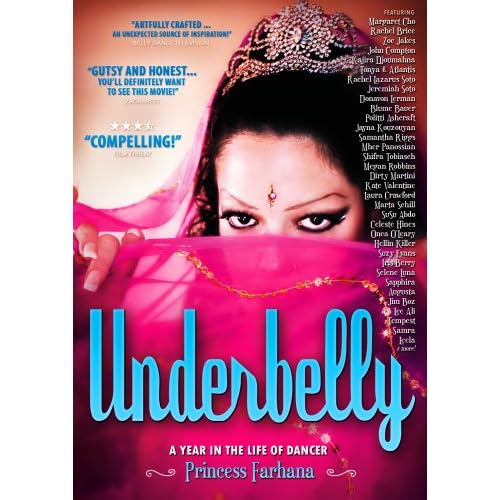
You never really know someone, until you get to know them. And even then, you become aware of the fact that we’re all just icebergs bobbing along through life, with huge parts of ourselves hidden from casual view. Last night Pamela and I attended the Los Angeles premiere of Underbelly: a Year in the Life of Belly Dancer Princess Farhana.
Pamela and I were introduced to the wild world of belly dance a few months before listing hopelessly towards burlesque. She studied with the oh-so lovely Jamilla, and as “Melita” our favorite troublemaker shimmied and undulated for the patrons of Dar Maghreb. Being the studious autodidact I fell in love with, she naturally consumed any instructional DVD she could find, which is what brought Princess Farhana into our house.
At the same time she was studying this ancient art, Pamela’s pole dance studies were trending towards strip tease, and ultimately burlesque. Princess Farhana was ever-present in this arena as well, her “Cool Moves for Hot Chicks” DVD was put on permanent rotation.
So we had seen Princess Farhana perform on video. It wasn’t until Pamela’s big debut at Stiletto 2.5 that we had the opportunity to see her in person. She performed a couple of numbers that night, a belly dance number and her clown burlesque number.
Speaking for myself here, Farhana is a rock star. She is one of the few performers in the burlesque community who actually makes me star struck. At the same time, Farhana seems incredibly approachable. This will sound weird to all but those who know him, but she reminds me of my father-in-law: Larger than life, salt of the earth. She's the kind of person who fills a room just by being in it, either in person or via anecdote, and everyone who knows her has a Princess Farhana anecdote.
If you dig documentaries as much as Pamela and I do, check out Underbelly! Even if you don't like documentaries, this one will convert you. It's a loving portrait of an inspiring hell-raiser.
23 December 2008
From TheRaider.net:
Speaking with TheForce.Cast, animation legend Paul Dini, who not only was the genius behind so many of the great Warner Brothers cartoons over the past 30 years from Batman to Pinky and the Brain, talked about Indiana Jones.
Paul Dini was a producer on Batman: The Animated Series. You may remember this series as "The Coolest Thing Ever Done With the Batman Franchise Before Christopher Nolan". Here's a reminder:
The series drew heavy inspiration from the Max Fleischer Superman cartoons of the 1940s.

I also recall reading somewhere that the artists started with black paper, instead of white, and cut into the darkness with color to make these wonderfully dark and shadowy images:

Dini would like to create an Indiana Jones animated series or feature in the same Fleischer-esque style. As Harry Knowles points out on Aint it Cool, many of the old Superman cartoons are in the vein of an Indiana Jones adventure:
Pretty nifty, huh? Aside from the racial stereotypes, of course. But doesn't this screengrab look right out of Temple of Doom?

That darn Lois Lane, always getting into trouble.

The Fleischer Superman cartoons were not very talky. The action sequences were long and well thought out. This could work! But what would it look like?
We can get an idea, by looking at the artwork of Eric Tam. Tam creates art posters with a 1920s "UFA" look. UFA was the German film studio that launched Expressionism as a film style. It's easy to see the influence of expressionism on the Fleischer cartoons above.
The Cabinet of Dr. Caligari:Metropolis:

Expressionism molted into film noir thanks to German filmmakers like Fritz Lang. Film noir was a further influence on the Fleischers and Batman: The Animated Series. I bring all of this up because Eric Tam created a couple of UFA-inspired posters for the first two Indy movies:

You have to put all of this together in your mental blender ...

... but I believe you will agree, what Dini is proposing would be nothing short of sensational. And Dini is in a position to make it happen; he's involved in The Clone Wars animated feature. So he's in the Lucasfilm loop.
Buzz, fellow Indy fans, buzz. The more we demand it, the more likely we are to fork over good money for it, the more likely George Lucas is to do it. After Indiana Jones and the Kingdom of the Crystal Skull, I think we can all agree: Indy deserves better, and so do we, the fans!
22 December 2008
A Draft from 10/22/08:
One of the great mysteries of the ages: Why did I title a play about burlesque dancers "Pin-Up Girls?"
To fully answer this question, we have to hop in the way-back machine and drop in on an acting class I stage managed back in 2005. (My God, has it been that long?)
Back in 2005, I knew practically nothing about burlesque, which is to say what I had studied in my college theatre history class. (insert rimshot.) I was dimly aware of this artform that involved women taking off their clothes to jazzy music. Burlesque -- that's like "Cabaret," right? One night, two of my classmates brought in a scene from "In the Boom Boom Room" by Larry Silverberg. Although the play is set in a 1960s go-go club, the actresses brought a much earlier flair to the piece. Also, I was watching a lot of Jimmy Stewart movies at the time. (did I mention that I was actually a student in the acting class? Oh well. My secret is out.)
Everything sort of congealed, and I scribbled down "The Secret Lives of Pin-Up Girls" on my notepad. Thus was born the play.
The idea was simple: What if Frank Capra or Howard Hawks made a movie about the backstage antics of 1930s or 1940s strippers? Simple and coarse. I had much to learn.
Pamela soon after discovered the art of pole-dancing and belly dance. Pole dancing led to an interest in theatrical striptease, and belly dance led to Princess Farhana (formerly of the Velvet Hammer, the westcoast spearhead of the neo-burlesque revival). As Pamela threw herself into her studies, I went along for the ride. Her success as a burlesque dancer is pretty well known to readers of this blog. (I like to kid that we're becoming the Jessica Tandy and Hume Cronyn of burlesque, but Hume looked better in his underwear.)
And so we come to the crux of the matter: pin-up models and burlesque dancers are not the same thing. There is certainly some overlap, as my friend Chris Beyond can attest, but for the most part we're talking two entirely different camps.
As I have worked on this play for the past three years, the title has been whittled down to "Pin-Up Girls." I should have changed the title to something more burlesque-centric, but once the first press release went out, I was stuck. Stuck like a pastie.
The meaning of the title has evolved since those first few scratches on a legal pad.
"Pin-Up Girls" refers in part to the subplots involving pin-up photos. But more than that, it is a statement of the play's philosophy. One of the striking things about those old pin-up cards is how much personality comes through the photo or illustration. They're not Photoshopped, plastic sex objects. The "Pin-Up Girls" of our play are likewise flesh-and-blood people with hopes and aspirations, heartache and private tragedy, i.e. "Real People."
A Draft from 10/10/08:
I really do have immense respect for Seth Godin.
He's on a tribe kick these days:
Brand management is so 1999.
Who does this work for? Try record companies and bloggers, real estate agents and recruiters, book publishers and insurance companies. It works for Andrew Weil and for Rickie Lee Jones and for Rupert at the WSJ... But it also works for a small web development firm or a venture capitalist.Actually, I see a lot of brand names here. Andrew Weil? Is he even a real person? I joke, but seriously, what the hell is Godin on about?
It must be difficult, being a guru. People are constantly looking to you to come up with the next big idea. Sometimes it seems like Godin is attempting not to reinvent the wheel so much as deinvent the wheel, invent a round thing with a hole in the middle, and give it a fancy name. It's frustrating for me, because I really do value what he does. The Purple Cow, The Dip, Unleashing the Ideavirus ... I dig his work.
We had an exchange on e-mail back in March, which I believe is illustrative of why I'm so frustrated. I started off the exhange in response to a blog he wrote, "A dumb branding strategy":
Jewelry Central is a really bad brand name. So are Party Land, Computer World, Modem Village, House of Socks and Toupee Town.Here's my e-mail response:
It's a bad brand name because Central or Land or World are meaningless. They add absolutely no value to your story, they mean nothing and they are interchangeable. "Here honey, I bought you these cheap earrings at Diamond World!" Not only are they bland, but you can't even remember one over the other. This is the absolute last refuge of a marketer who has absolutely nothing to say and can't even find the guts to stand for what they do. It's just generic.
Seth -I was hoping for a more robust exchange on the matter. I know, silly me: Seth Godin is a big, important marketing guru, and I'm a self-described "puppeteer and theatre guy." What I got was a toss-off response:
Interesting blog yesterday ("a dumb branding strategy.")
Yes, the way they have been thrown around, words like "central" "land" and "world" have become generic (I would add "zone" to this list.) In each example you give, these words have been paired with generic words (Jewelry, Computer, Toupee, Modem, etc.) This is just incorrect usage.
Pair an established brand name with any of these generic location words, and you do have something remarkable. Case in point: Disneyland.
What's the story? If you love Disney, and all the wonderful experiences Disney products give you, here is a place you can go to where you will literally be immersed in Disney. It is a destination, not just a generic word writ in neon on a storefront.
I think the "dumbness" of using these words in all their generic glory arises from arbitrary usage, not from the words themselves. In other words, not taking the time to come up with a story in the first place: "We sell socks. Uh ... 'Sock Town.' That'll do."
(I see you'll be taking up 'Radio Shack' and how this name was a liability. I think 'Radio Shack' is brilliant and tells the right story ... once upon a time. The name hasn't kept pace with technology, and nowadays no one except ham radio nuts and electronics hobbiests know [or even care] what the hell a 'radio shack' is. So how do you take an established name like 'Radio Shack' and re-brand it for the age of iPods and Hi-Def?)
-- Andrew Moore,
puppeteer and theatre guy in Los Angeles
right. And Disney, of course, is not generic.Thoroughly missing the point, and changing the thrust of the argument at the same time. I believe this is called "hand waving" in the parlance of online debate.
I responded back to him, in a likewise terse manner:
In the 1950s? It was a specific flavor.... and heard defeaning silence. I unsubscribed from his RSS feed after this exchange, completely disillusioned by the bald man's lack of common sense and understanding, two qualities I had supposed he had in abundance, based on his books. (I realize now that the e-mail response I got was most likely from an intern or other lackey, and Godin probably never read my well-reasoned retort.)
I could post a bunch of YouTube videos and links to websites regarding the opening of Disneyland in the 1950s to support my argument, but I believe it's pretty self-evident. It's in the freaking name: Disneyland. If the park were called "Cartoonland" I would agree with the assessment of "generic."
I was also looking forward to defending Radio Shack. Here's what Wikipedia says about the name:
The company was started as Radio Shack in 1921 in Boston, Massachusetts, by two brothers, Theodore and Milton Deutschmann who wanted to provide equipment for the cutting-edge field of amateur, or ham, radio. Theodore and Milton Deutschmann opened a one-store retail and mail-order operation in the heart of downtown Boston on Brattle Street, near the site of the Boston Massacre. They chose the name "Radio Shack," which was a term for the small, wooden structure that housed a ship's radio equipment. The Deutschmanns thought the name was appropriate for a store that would supply the needs of radio officers aboard ships, as well as "ham" radio operators.For the people they were selling to, the name made perfect sense. It conjured up a world of adventure on the high seas, of long-dstance comunication devices slapped together and kept running by hand. It's a name that has become gradually obsolete to all but the die-hard electronics types who still go to Radio Shack to buy diodes and capacitors and such.
So there you go. My Seth Godin Problem. I like the guy's work, but he can be pretty dense at times. Just like all of us.
A Draft from 8/23/08:
It seems I'm just not going to be able to crank these things out weekly. Rehearsals for my new play, Pin-Up Girls, are picking up steam and time is at a premium. (I'll be telling you all about Pin-Up Girls in the coming weeks.) In the meantime, I'll keep plugging away at these "Artists I Love" profiles every chance I get.So without further adieu ... the dancer with "four feet of red hair, and miles of bad intentions":

(Above is one of the best burlesque photos ... ever. Laura Creecy is an incredible artist. If you're wondering what I'd like for my Birthday, a Laura Creecy print would be a good place to start.)
I'm going to come right out and say it: Scarlett Letter is a hypnotist. If you're familiar with the working side of live theatre, you no doubt are aware that there are two basic positive responses an audience can give a performer: wild applause and complete silence. There is some debate as to which is the better response. On one hand, an audience moved to thunderous hand-clapping is an audience elevated. The complete silence reveals a sort of engaged reverence for the performer. It's a toss up, really.
One night, watching Scarlett dance, it occurred to me that the audience wasn't whooping and hollering as much as usual. I glanced around and observed a rapt audience, complete attention on Scarlett's performance.
She's a slinky dancer; a rhythmic, whirling flame. She reminds me of the burlesque dancers who come from the belly dance tradition, but I don't think that's her background. She's an accomplished costumer with a baroque eye for detail. Her costumes are works of art. The music she selects for each number is yet one more thread she weaves into the tapestry of her act. It could be said that Scarlett composes her burlesque numbers, in the truest sense of the word.
Scarlett Letter co-produces the Monday Night Tease with Lili VonSchtupp, and can be seen dancing all over town.
A Draft from 2/29/08:
I like Chris Anderson. His "long tail" idea makes sense and is manifestly real. It only benefits the aggregators, not necessarily the independent content producer, but that's been true since the dawn of time. At the very least, he's managed to form an easy to comprehend description of how one segment of the free market works.
But this new idea is just crazy talk: "Free! Why $0.00 Is the Future of Business"
This is insane. Why not give away cars, and charge $15 a gallon for gas? There Ain't No Such Thing As A Free Lunch. The loss of profit in one area is made up in other areas. Like a supermarket that slashes prices on milk but raises the price of eggs. Like me. I got a fancy razor in the mail for 'free'. If I want to continue using it, I have to pay $15 for a pack of disposable blades.
He says "But Friedman was wrong in two ways. First, a free lunch doesn't necessarily mean the food is being given away or that you'll pay for it later — it could just mean someone else is picking up the tab." That's not free! Someone is picking up the tab.
"Second, in the digital realm, as we've seen, the main feedstocks of the information economy — storage, processing power, and bandwidth — are getting cheaper by the day." Cheap. Not free.
He should maybe spend a little more time reading the late Milton Friedman, and less time assuming Milty's wrong simply because he's old school.
A Draft from 1/21/08:
There is something about trading art for money that feels a bit strange.
I've known artists who have given away demos and t-shirts at concerts (at a financial loss) and I've known artists who discount and comp theatre tickets like it's going out of style. I know first hand how difficult it is to set a price on my own artistic output.
Although it may feel "noble" or "ethical" or just good to give away art, it is important not to for two reasons:
- 1. Artists have bills to pay, and
2. Giving your stuff away all the time devalues you as an artist.
The second reason bears some fleshing out.
Seth Godin makes this point as an aside in a recent blog entry:
It's important to charge something, because the act of paying fundamentally changes the dynamics of the relationship.That quote is what got me to thinking about this subject again. It reminded me of a white paper I read a couple years back about how access to free music downloads breeds listener apathy. When a listener is able to rip literally any song ever recorded from the net without a pricetag attached, music as a whole loses value for that listener. It's taken for granted, in the truest sense of the words.
It's the old "why buy the cow when you can get the sex for free" situation.
Free stuff has no value. That's usually why it's free. Giving away art may feel good, but ultimately it does nothing for your audience. In fact, I believe that exchanging artistic output for money is good for the audience. It validates their aesthetic taste and adds value to the experience. It makes the decision to go see a play or a certain musician in concert far more precious and important. It invests the audience more deeply in the experience.
If you look at it as a "greed" issue, you're missing the point (and I'm afraid many people do). The reason we have an monetary system is because I can't pay for my meals directly with the work I do at my day job. A barter system may work in an agricultural society, but trading chickens for iPods is not a workable scenario. Money is a value holding device, a stand-in for the work that went into earning it. When I buy orchestra seats at a John Mayer concert, I'm actually paying a certain number of hours of my labor. I'm investing my productivity into the aesthetic experience of hearing the music I enjoy. Going to a concert is not just a fun activity, it's a reason to get through the work week. It's something to get excited about. It's important.
I suppose I'd be just as excited if I got to see a John Mayer concert for free. But there'd still be value attached: I know how much John Mayer tickets cost. If all he played were free concerts ... well, they'd have to be extremely rare. Or in a remote location. Or something, some hurdle that would require a special effort to gain the experience.
You can't get anywhere in a frictionless universe. Giving away your art takes the friction out of the experience. There are no barriers to push against to gain the experience; it just sort of washes over the audience. I guess you needn't charge money for art. You could make it physically difficult to get to the experience. The only problem is, sending your audience on a scavenger hunt to find you doesn't keep the lights on at home.
(I should add that giving away something as a marketing action is a completely different matter. The idea is the same as those little pink spoons at Baskin Robbins: Let people get a taste to see if they like it, then sell them a double scoop.)
A draft from 9/11/07:
Another gem from Seth Godin:
History is littered with inventors who had "great" ideas but kept them quiet and then poorly executed them. And history is lit up with do-ers who took ideas that were floating around in the ether and actually made something happen. In fact, just about every successful venture is based on an unoriginal idea, beautifully executed.I am always astonished to meet writers and artists who keep their "one really good idea" under lock and key. I wonder if the idea ever sees the light of day.
I'm even more astonished when that writer or artist is me.
11 December 2008
It is so peculiar to see something online and then stumble across it in life. I became aware of this strange sensation, the feeling one gets when the online world and "real" world collide, when standing on line for "Tenacious D in The Pick of Destiny" back in 2006. Pamela and I saw this guy:
... who had existed only as a YouTube video before this. (There should really be a term for this. It's not a new sensation. It's the feeling you get whenever you encounter in the real world what you've known only from secondary sources.)
I remember the first time I saw David Liebe Hart. It was the following video, linked to by puppeteer Andrew Young. You don't have to watch the whole thing to get the idea:
I think the video speaks for itself.
I have IMMENSE respect for David Liebe Hart. Criticize his skill, his song lyrics or his theology all you want, the guy gets it done. And he's been getting it done since the 1980s, apparently. To paraphrase Darryl Philbin, David Liebe Hart is a very brave man. It takes courage just to be him.
And he is beloved, perhaps for his work on the Tim and Eric Awesome Show. But I have a feeling that many of us who consider ourselves fans of David Liebe Hart find the huge ripple of pathos present in this, the under-est of underdogs quite endearing:
I got to meet the man at Peepshow Menegerie last Sunday night, where we both performed. I'm most likely going to build him a puppet.
He's definitely his own person, and I respect that.
(The camera man said "ready?" and we both smiled. Then David started talking, just as the flash went off. I think this picture is perfect.)
08 December 2008
Making The Felties a RealityWhat's it going to take?
I set up a MySpace page for "The Felties" two years ago. And by "page" I mean "log-in". I hadn't even checked the e-mail account associated with The Felties in months. I logged in last week, and discovered my MySpace page was in danger of deletion. Oops.
I passed the third anniversary of this blog a couple of months ago (woo hoo!) and it has finally dawned on me that "The Felties" has been percolating for -- oh, about five years. It's no "Chinese Democracy" but even by my standards, that's pretty bad procrastination.
I haven't done anything on this project since December of last year, when I spent half of a day thinking up "blue" material. That didn't go too well.
I feel a bit trapped by "The Felties." As I wrote to a colleague in an e-mail from January of this year:
I've taken a huge time-out from The Felties. It got to the point where nothing I can do on the project will satisfy what I 'want' to do. I don't want it to look as crappy as Disembodied Animal Head Theatre, for example. I was working on a related project with a producer friend (I did some puppetry on a children's pilot he put together) using two of the Felties characters, but I have such a clear cut idea of what The Felties are, I'm just too unwilling to let someone else monkey with the characters. Maybe I'm being a bit obsessive. So I'm stepping back and giving it some air.
I really want to do something (anything?) with "The Felties." At the same time, I don't want to do something that sucks. The problem is that the idea is fully realized in my imagination, and there is literally no way I can duplicate it in reality. Not with my limited resources.
I'm a theatre guy, so I know all about "making do" and "keeping the show on the road." But this is different somehow. I just can't seem to wrap my head around it; making the compromises I'd have to make in order to get something done. (I toyed with the idea of putting the entire property -- puppets, designs, scripts, logos, websites, etc. -- on eBay. I'd undoubtably reneg on the auction.)
I think I'm going to just have to do something. Resign myself to the fact that it's not going to live up to my wildest expectations, and instead let it live. The first webisode will be crappy, but it will be.
Evolution is a part of life, and I should take my own advice more often. A quote I frequently reference from the song "The Sojourn of Arjuna" by the inimitable Future Man comes to mind:
Plenty of artists I respect have been down this path before me:A man must go forth from where he stands. He cannot jump to the absolute, he must evolve toward it.


You make do, and improve as you go.
Let's hope I don't let another year pass before I do something with "The Felties." It's time to buck up and take that first step.
04 December 2008
I've tried to do this properly, but they keep calling me. I've asked off their call list NINE times, twice via e-mail. I've received three calls from them in the past twenty-four hours to attend a screening of Paul Rudd's new movie "I Love You, Man." The reservation line for that screening is 888 886-2864. Supposedly, that's the number you call to opt out of their service. At least that's what the pre-recorded voice tells me. These are robocalls, and nothing is more annoying than robocalls.
The calls come from (801) 741-5500, a number that is disconnected if you try to call it. They also have a website, www.thescreeningexchange.com, but the only e-mail they offer is support@thescreeningexchange.com. This is their catch-all e-mail address, so who knows if they ever get around to reading the mountain of e-mails they must get.
Plain and simple: I've asked off of their phone list many, many times. They have failed to comply with my requests. They do bad business. It's a bad sign when a company fails to provide on their website seperate e-mail addresses for different issues or a toll-free number to call.
Avoid them.
02 December 2008
In the past year I've built a couple of puppets for performance:
Spike, Theatre Unleashed's mascot. Last year I brought an old friend back to life:

Pepper, based on the Glorified Sock Puppet pattern from Project Puppet.
Project Puppet has helped me get over my bad self and gain confidence as a puppet builder. I know how to sew. Like many puppet nerds, I spent many an evening in high school hand stitiching an attempt at a Kermit replica. However, there is a gaping void between knowledge and confidence that can only be bridged by practice.
Which leads me to my latest puppet project, the crocodile:
The eye and nose ridges are temporary. After I finish building the head, I'll cover it with fabric and attach fabric covered ridges. I tacked these temporary jobs on to give a sense of what he's going to look like when finished.
One thing I've learned is that puppets can be deceptively small. Kermit's head is just enough fabric to cover a grown hippy's hand. Knowing that, compare the size of Kermit to the other Muppets. Not very large! The first foam-head puppet I built, a "big bad wolf" back in college was HUGE! I know that the torso of this croc can't be longer than my arm, which has dictated the size of the head.
I started with the mouthplate on this guy. Covered it in black felt and then added the foam for his snout and head. The crown of his head is the same "foam wedge" approach that I learned from Andrew Young's Tumbles P. Bear Project.
I'm not a bad draftsman. Even at my most disparaging of my puppet building skills, I've arrogantly trumpeted my ability to put pen to paper and design puppets.

(Above is "Skip," an unrealized design for a crappy children's show idea I once had.) So here's a secret that I gleaned from the great St. James Henson: It's all about the silhouette. The way we humans are built, we have an innate ability to rapidly identify silhouettes. If the overall shape is right, you can fudge the details. This is how we know Mickey is a mouse and Kermit is a frog, even though they really bear little resemblance to their namesakes.
The croc puppet is all about silhouette. I'm building it pretty much on the fly, without drafting it before hand, but I have plenty of visual references to work from. (Google image search is a gift from the gods.) I'm very pleased with how this latest puppet is turning out, and felt that it was time to admit what a few people have been telling me for the past year: I do know how to build puppets.
01 December 2008
I've had a much harder time "getting back to reality" after the close of Pin-Up Girls than I have after any other play in which I have been involved. The four day holiday weekend did not help. There was a certain quality to the comraderie that developed backstage, a quality that I exposed myself to as often as possible. I even slipped backstage during intermission each night to hang out with the cast. It was pleasurable, and addictive. Naturally, being deprived of it has led to some withdrawal pains.
Being the kind of man I am, it is moments like these that lead me to quoting Kermit the Frog:
Yeah, well, I've got a dream too, but it's about singing and dancing and making people happy. That's the kind of dream that gets better the more people you share it with. And... well, I've found a whole bunch of friends who have the same dream. And that makes us like a family.
Truer words have never been spoken by a frog.
Theatre has an ephemeral property, and theatre folk are constantly on the move, transitioning from project to project. This is equally true of all the performing arts, but unlike movies and television, we don't have a DVD copy at the end of the day. I believe this is a good thing. There is nothing more exciting and bracing than uncertainty. Yes, uncertainty can be quite worrisome, as in waiting for the results of a blood test or an election. But there is that incredible rush one gets when boldly facing the unknown and stepping forward into the inky blackness.
I would like to call this attitude "owning the future" and here do state that it is a quality germain to the artist, entrepreneur and explorer. (All three of these are essentially the same person, by the way.) "Owning the future" sounds better than "chasing the next fix" at any rate.
Theatre Unleashed, part of my Los Angeles family, continues to own the future. The great thing about being strong in numbers (and we have grown to just over forty members in less than a year) is our capacity to hit the ground running with our next production. At the moment that next production is The Holidays Unleashed, a variety show similar to May's Theatre Unleashed Presents Theatre Unleashed Starring ... Theatre Unleashed!!! This shall be the perfect bookend to a perfect season. And so I leave you with the particulars of our final offering for 2008:
Directed by Darci Dixon and Phillip Kelly
Produced by Theatre Unleashed
SYNOPSIS:
Done in the tradition of holiday variety shows of the 1950s and 60s, The Holidays Unleashed features a plethora of entertaining acts. Lead by two Rat Packish (in theory) emcees, the show features a few classic holiday song and dance numbers, a traditional caroling group called The Figgy Puddings, a disturbingly sexy burlesque piece, lots and lots of slapstick and a few skits involving everyone’s favorite20holiday celebrities. But the real fun begins when the show starts to…well…stray a little off course. The all-important holiday message, though, remains intact throughout.
DATES AND TIMES:
December 15
Monday, 8 p.m. (doors at 7 p.m.)
*Meet and greet with the actors after the shows.
LOCATION:
M Bar
1253 N. Vine St.
Hol lywood, CA 90038
TICKET PRICES:
General Admission: $10
*Plus $10 food and drink minimum.
INFORMATION & RESERVATIONS:
Reservations Strongly Suggested!!!
For reservations, call (323) 856-0036
For further information, please call: (818) 849-4039Or check out our website at: http://www.theatreunleashed.com/

24 November 2008

One thing I'll miss for sure is this tux jacket. HOT!
I hosted The High Jinks Burlesque, a 1940s-style after show no Saturday nights. I brought the ukulele into the show the second weekend, performing a "chanson et ballet" with Mr. Buddy (comedy savant Phillip Kelly). I played and sang "Tonight You Belong to Me" as Mr. Buddy danced around. After the third verse, I threw it to Mr. Buddy who played a slide whistle and bicycle horn solo.
The third weekend, I began opening with "Blue Skies" with a "bilabial fricitation" solo halfway through.
The fourth weekend, I somehow managed to convince Mr. Buddy to sing "It's a Sin to Tell a Lie," which became quite a performance piece.
He and I will be hosting the Monday Night Tease on the 29th of December. Who knows what shenanigans we'll have worked out at the last minute!
Hmm. I need to buy a satin and velvet tux jacket.

Wow.
I haven't slowed down long enough to really let it sink in. As soon as the audience cleared, we began the strike (at around 9:30) and were out of there by 11:45. That's a phenomenally short strike. And easily the last 30 minutes or so were spent taking stuff out to the car. I had forgotten how much stuff Pamela and I brought into the space for this play.
Got home, unwound a bit, crashed. In the morning peeled myself out of bed and went to work. Rode my bicycle to work. Oh yeah -- I picked up a used bicycle last week. I'm working close to home now, and have the option. I haven't spent so much time on a bicycle since before I started shaving, so I'm super exhausted this morning.
There have been many moments over the course of this production when I took the time to mindfully observe my surroundings; to try and comprehend the chain of events and great fortune that brought me to the Avery Schreiber with a perfect cast, a fun script, and such wonderful houses night after night. I have a record of one such moment in my e-mail inbox, a text message I sent myself at 12:58 am this past Saturday morning. Into my second or third drink at the Red Lion Tavern in Silverlake, surrounded by my favorite people, I was moved to text myself: "i am full to bursting."
Every weekend of this show involved some sort of get-together. We didn't have a "wrap party" per se, but rather a series of celebrations, culminating in a pot luck dinner between the matinee and evening performance yesterday. (As a side note, may I say that the spread of yum yums was a near-perfect metaphor for my cast: Everything offered was desirable and delicious with nary a dud.) At the pot-luck I gave my usual "aw shucks, thanks a lot" speech. (For someone who enjoys the sound of his own voice so much, you'd think I'd be better at giving speeches.) The highlight was Jovial Kemp's heartfelt thank-you to cast and crew. I think he was full to bursting, too.
My cast played to an almost sold-out house for their last show. I believe we were technically sold-out, but we had a couple of no-shows. Irregardless, for a Sunday night the number we had was extraordinary. I had my weepy moments throughout the show. Strangely, the worst moment was not in the last show at all, but the Saturday night show. It hit me in the first few minutes that this was all going to end, resulting in an embarrassing display thankfully unseen by my actors (I was sitting on the front row).
The show ended, the audience congratulated and mingled with my actors. The strike began. An attempt was made to ruin what was otherwise a triumphant evening for myself, my cast, my crew and my company. She failed. 'Nuff said.
It is the nature of theatre that eventually, a show ends. Unlike literature, where the physical book lingers on, gathering dust and silverfish on a bookshelf; or film, where one can still pop in the DVD or stream it online long after the last residual checks have been written; there is precious little left over after the run of a play. And in this drawback I note a strength: A play never grows old, never grows dusty. It remains, a moment in time remembered. The faces, the sounds, the emotions we felt continue on, a part of us. It has a vibrancy that never fades.
Thirty, forty, fifty years from now, I'm going to be that guy backstage telling enraptured young actors all about the time I directed a play set backstage at a burlesque club in 1940s San Francisco. About how Bryan broke the set the first night, and the fleeting look on Jovial's face the one time his music didn't play. About the unearthly squeal Alana let out when Jovial poked her, and the scream of frustration Sylvia let out when her onstage partner "quit" the show. About silence in the house when Seth and Pamela ended their onstage relationship. The look of crushing defeat on Sarah's face every time Seth said "thank you." How Burnsy took a few lines about the death of her character's husband and made me cry almost every night. The applause after April stopped the show and topped Sophie Tucker. The nuances of Judith's work, how she always found something new to tweak and never failed to make me laugh. Jumping up and down on the sidelines as Foxy finally showed her pasties at the last after show.
This experience is forever a part of me. I am a far richer person for having it. And my cast and crew have my undying gratitude and devotion.
(Especially that "red-haired pain in my ass" for whom I wrote the show. I don't know if I've mentioned it, but I'm absolutely crazy for her.)
21 November 2008

Right Where I Want to Be
As we enter the final weekend, I would like to take a moment and reflect on what we (meaning Theatre Unleashed, and my cast and crew) have accomplished.
Five months ago, I sat down in front of my laptop and cranked out a first draft. Two and a half months ago, we began rehearsals. A month ago, we opened. In less than half a year, an original work has grown from one guy sitting in front of a computer to an organism composed of dozens of people, each one contributing to telling the same story.
The amount of hard work, sacrifice, dedication and commitment that has gone into this thing has tremendous value, and it is an investment that has paid off in spades. Reviews in major publications, sold-out performances, offers of further work -- but most important, delighted audiences.
No production is without its drama. What is incredible to me is that this show has had only one source of "drama," and she has thankfully kept her nonsense on the margins. The rest have comported themselves with the utmost professionalism and esprit de corps. I would work with any one of them again, and look forward to it.
I hope it isn't too narcissistic of me to say this, but I am pleased to find myself doing what I want to do in life, and succeeding at it. I feel blessed. I feel enriched by the experience. The success of Pin-Up Girls has stoked up the fire in my belly, and I can't wait to do this all again!